
Passenger Safety · September 8, 2026
Before You Book a Limo in Los Angeles: How to Check If a Company Is Licensed and Insured
A licensed California limousine company carries a TCP permit, at least $750,000 in commercial liability insurance and an LAX airport decal. Here is how a passenger can check all of this in under a minute — starting with the license plate.
Los Angeles has no shortage of companies advertising luxury transportation. Some are fully licensed professional operators. Others are individuals with a nice car, a website and none of the legal requirements — which becomes your problem the moment something goes wrong, or when the driver is turned away at the airport curb.
The good news is that the State of California and Los Angeles World Airports make legitimate operators easy to spot. You do not need to be an industry insider to verify a company before signing a contract or sending a deposit — you need to know where to look. This guide shows exactly what a professional chauffeur company must hold, and the two visual checks you can make the moment the car arrives.
The TCP permit: the license that makes a limo company legal
In California, every company that transports passengers for hire — limousines, executive sedans, SUVs, Sprinters — must hold a TCP number issued by the California Public Utilities Commission (CPUC). TCP stands for Transportation Charter-Party carrier. Without it, the company is operating illegally, full stop.
The TCP number is public information. You can ask the company for it before booking and verify it on the CPUC's carrier lookup. A legitimate operator will never hesitate to share it — at Exodus Limo Service, ours (TCP 43964-A) is printed in the footer of every page of this website. If a company cannot or will not provide a TCP number, do not book with them.
Commercial insurance: the $750,000 liability minimum
California requires passenger carriers to carry commercial liability insurance of at least $750,000. This is not a courtesy — it is what protects you if there is an accident during your ride. A driver operating on a personal automobile policy is not covered while carrying paying passengers, which means in practice that you are not covered either.
This is the quiet risk behind suspiciously cheap quotes. A car with no commercial insurance can always undercut a licensed operator. When you verify the TCP number, you are indirectly verifying insurance as well: the CPUC requires proof of the $750,000 minimum before it issues or renews a permit, and suspends carriers whose coverage lapses.
The LAX airport permit: why it matters to your flight
LAX is a separately regulated environment. To pick up or drop off passengers inside the airport, a commercial vehicle must hold a current LAX ground transportation permit — issued only to operators who can prove, among other things, that they carry at least $750,000 in commercial liability insurance.
That last point is the useful one for passengers: an LAX permit is effectively a guarantee that the company's insurance and licensing are in order, because the airport verifies them before issuing the decal. An operator without the permit risks being stopped by airport police or LAX enforcement inside the terminal area, and the vehicle can be impounded on the spot. For the passenger, that means standing at the curb with luggage, no car, and a departure clock that does not stop. People have missed flights this way.
Check one: read the license plate
The first visual check takes two seconds. In California, commercially registered vehicles carry a commercial license plate, and the format gives it away: a commercial plate is almost entirely numbers with a single letter — like 12212K4, the plate in the photo below. A regular personal automobile plate mixes several letters and numbers.
If the car sent to pick you up wears a standard passenger plate, you are almost certainly looking at a personal vehicle being used for hire — which means no commercial registration, and very likely no commercial insurance behind it.
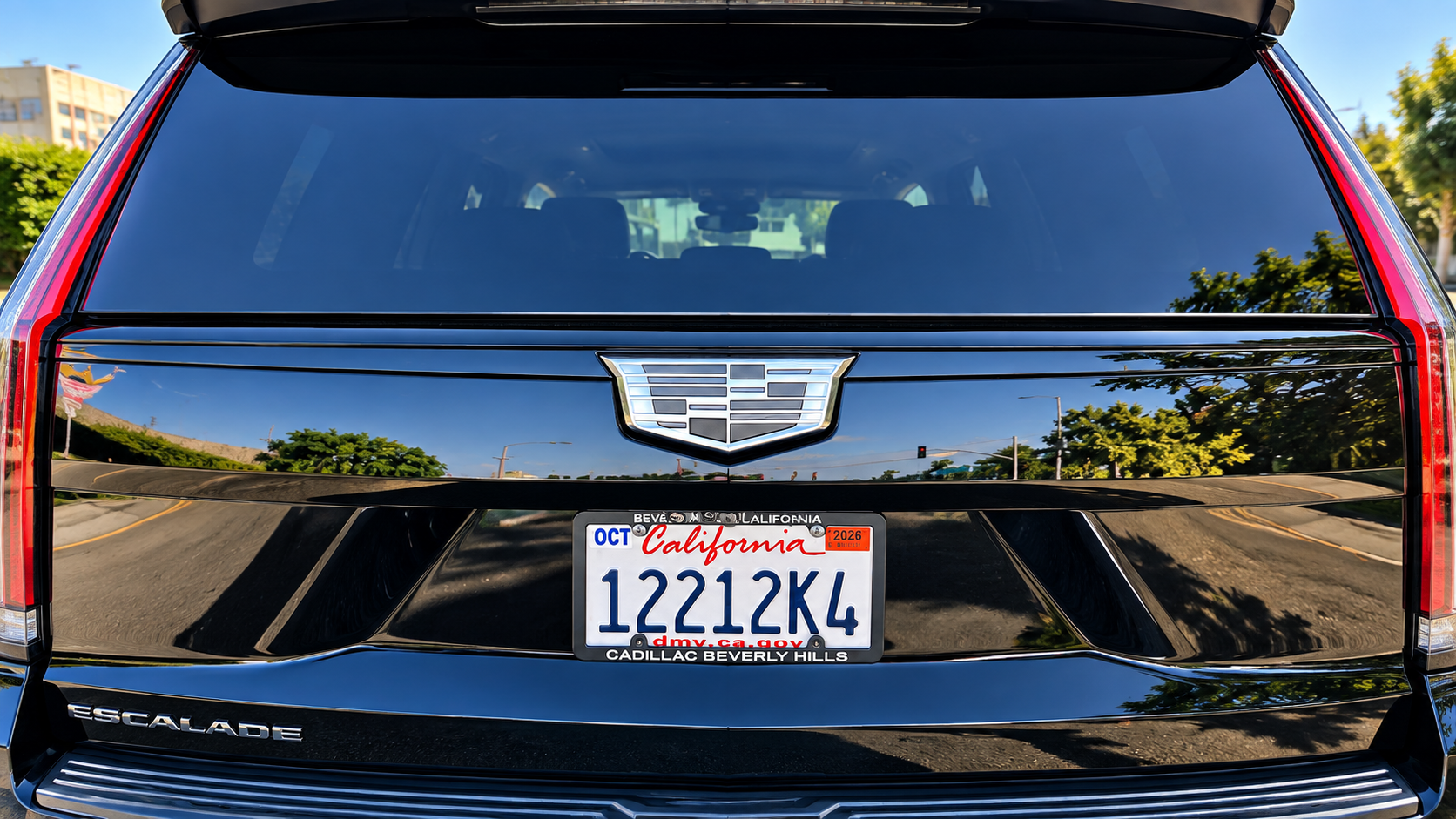
- Commercial plate — mostly numbers with one letter (e.g. 12212K4). This is what a licensed limousine or executive SUV should wear.
- Personal plate — a mix of two or three letters with numbers. A red flag on any vehicle you are paying to ride in.
- TCP number on the bumpers — vehicles permitted to operate at LAX must display the company's TCP number on the front and rear bumper, in the size and color the CPUC prescribes. A car that wears neither a commercial plate nor a TCP number is not a permitted commercial vehicle.
Check two: look for the LAX decal on the windshield
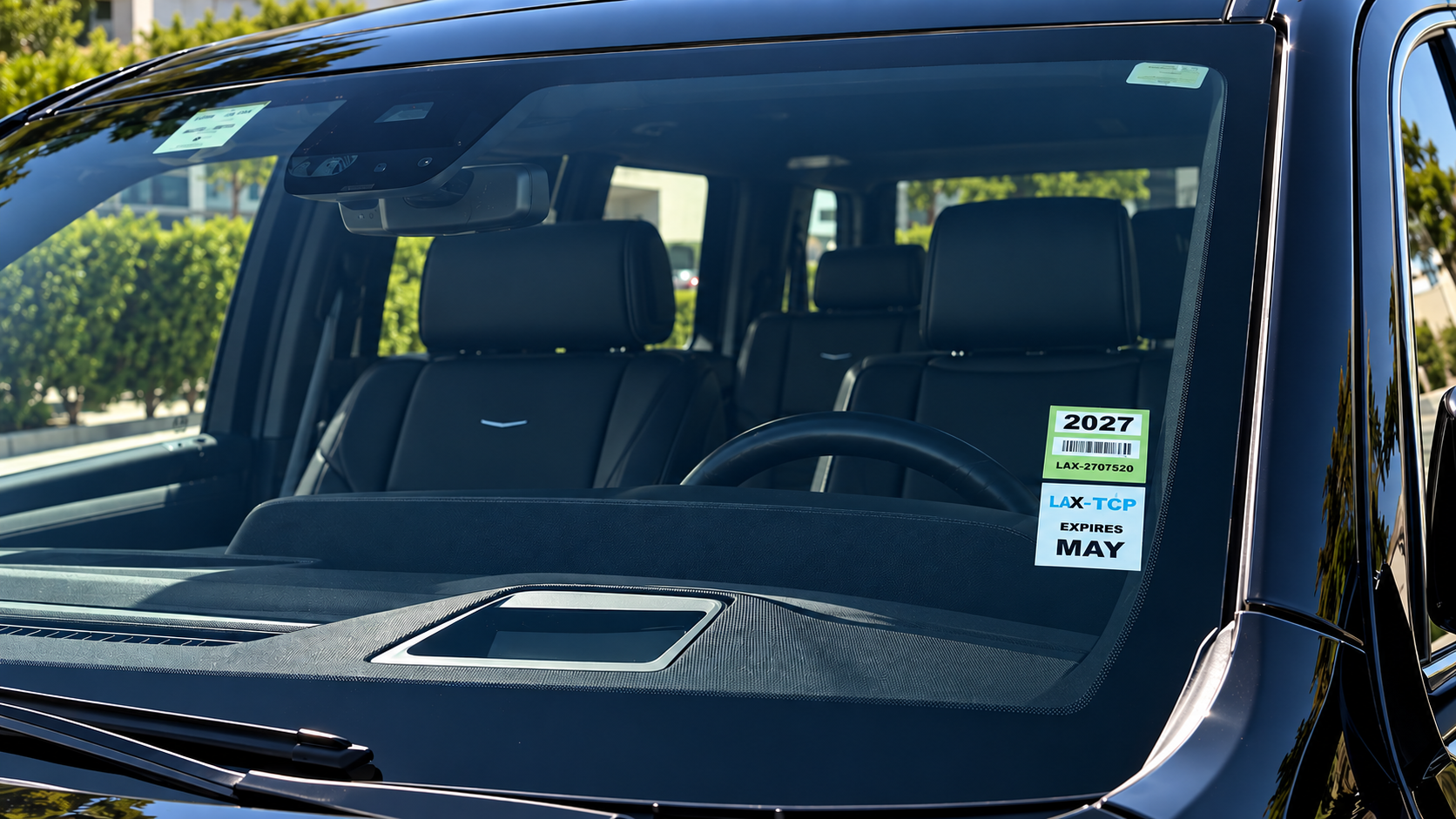
The second check is the windshield. Every vehicle permitted to operate commercially at LAX displays a ground transportation decal showing LAX, the expiration month and the expiration year. It is small, discreet, and placed on the lower corner of the glass — and we photograph our own fleet's decals so you know exactly what it should look like.
The photo below shows exactly what to look for. It sits on the driver's side, in the lower corner of the windshield, and it is how you read it: the lower sticker names the airport and shows the month — LAX issues its own permit, and so do other airports, each with its own sticker — while the sticker above it shows the year. The vehicle in the photo, for example, is permitted through May 2027; when that month arrives, the permit has to be renewed.
It is worth making this a habit every time you get into a chauffeured car. If this decal is not on the windshield at LAX, the driver may not carry the appropriate insurance for that kind of work — and if airport police stop the vehicle inside the terminal area, the driver can be cited and the car impounded and towed on the spot. For you, that means standing at the curb with no ride to your destination, while the clock on your flight keeps running.
There is a second item on the glass worth knowing about: alongside the decal, every permitted vehicle carries an electronic LAX transponder — usually a sticker with a built-in metal antenna, occasionally a small box — that registers the vehicle's entries into the terminal loop for the airport's access fees. LAX issues the transponder to one specific vehicle: permits and transponders are not transferable between cars, so the credentials on the glass belong to the vehicle you are actually riding in.
If the decal is there and current, you can board with confidence: LAX only issues it after verifying the operator's permits and insurance, so a valid decal is shorthand for the entire compliance chain. If there is no decal, the vehicle is not authorized to work the airport — and you should expect exactly the kind of curbside trouble described above.
The one-minute verification checklist
You do not need to take anyone's word for anything. Before you sign a contract or send a deposit, run this list:
- Ask for the TCP number and confirm it with the CPUC — a legal operator shares it freely.
- Confirm commercial liability insurance of at least $750,000 (the California minimum for passenger carriers).
- Ask whether the company holds a current LAX ground transportation permit if any airport pickup is involved.
- When the car arrives, check the plate: commercial format means commercial registration.
- Confirm the TCP number is displayed on the front and rear bumpers, as required for LAX-permitted vehicles.
- Check the windshield for the LAX decal with a current expiration month and year, alongside the vehicle's transponder.
Why we publish our credentials
Every vehicle in the Exodus Limo Service fleet operates under a TCP number, carries commercial liability coverage that meets California requirements, and displays a current LAX ground transportation permit. Our TCP number is printed in the footer of this website because a professional operator should make verification easy, not hard. When a partner operator performs a trip, the vehicle on the job carries its own current TCP permit.
The visual checks above cover the car itself. For the questions worth asking the company before you book — who employs the driver, who actually performs the trip, how to read a quote that looks too good — see our companion guide, questions to ask before booking a chauffeur in Los Angeles.
If you are comparing companies for an airport transfer, a corporate program or an event, use the checks in this guide on everyone — including us. And if you would like a quote from a fully licensed operator, our LAX airport car service team and corporate transportation desk are available 24/7.
Keep reading
Travel Resources
Los Angeles Traffic, Emergency Numbers & Useful Resources: A Traveler's Guide
Los Angeles Guide
Los Angeles After Dark: A Chauffeur's Guide to Nightlife, Dining & Getting Around
Los Angeles Guide
The Best Beaches in Los Angeles: A Local Transportation Guide
Chauffeur Standards
What Is a Black Tie Chauffeur Service? The Exodus Limo Service Standard
Traveler Guides
Questions to Ask Before Booking a Chauffeur in Los Angeles: A Passenger's Checklist
Airport Guides
LAX Pickup Guide: Curbside Columns, Letters and Numbers Explained
Travel Planning
Best Times to Fly Out of LAX, Burbank, John Wayne and Long Beach
Los Angeles
Los Angeles Freeway Rush Hour: When Each Corridor Actually Moves
Events
LA28 Olympic Games: How to Move Around Los Angeles in Summer 2028
City Guides
The Los Angeles Metro, Explained — and When a Car Still Wins
Los Angeles Guide
Los Angeles Is an Events City: Getting Around Concerts, Conventions and Big Dates
Los Angeles Guide
The Best Places to Visit in Los Angeles: Museums, Zoo, Aquarium and Piers
Airport Updates
Hollywood Burbank Airport's New Terminal: Everything Travelers Need to Know
Reserve your chauffeur
Confirmed reservations, transparent pricing and 24/7 dispatch.